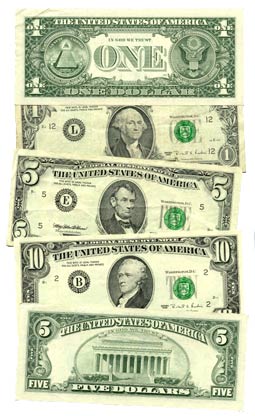
Showing posts with label HISTORY. Show all posts

Thursday, August 5, 2010

AMERICAN DOLLAR


The history of the dollar in North America pre-dates US independence. Starting with the issuance of Early American currency called the colonial script, in which the issuance of currency was equal to the goods and services in the economy. Even before the Declaration of Independence, the Continental Congress had authorized the issuance of dollar denominated coins and currency, since the term 'dollar' was in common usage referring to Spanish colonial eight-real coin or Spanish dollar. Though several monetary systems were proposed for the early republic, the dollar was approved by Congress in a largely symbolic resolution on August 8, 1786. After passage of the Constitution was secured, the government turned its attention to monetary issues again in the early 1790s under the leadership of Alexander Hamilton, the secretary of the treasury at the time. Congress acted on Hamilton's recommendations in the Coinage Act of 1792, which established the dollar as the basic unit of account for the United States. The word "dollar" is derived from Low Saxon "daler", an abbreviation of "Joachimsdaler" – (coin) from Joachimsthal (St. Joachim's Valley, now Jáchymov, Bohemia, then part of the Holy Roman Empire, now part of the Czech Republic; for further history of the name, see dollar.) – so called because it was minted from 1519 onwards using silver extracted from a mine which had opened in 1516 near Joachimstal, a town in the Ore Mountains of northwestern Bohemia.
Because gold and silver in the open marketplace vary independently, the production of coins of full intrinsic worth under any ratio will nearly always result in the melting of either all silver coins or all gold coins. In the early 1800s, gold rose in relation to silver, resulting in the removal from commerce of nearly all gold coins, and their subsequent melting. Therefore, in 1834, the 15:1 ratio of silver to gold was changed to a 16:1 ratio by reducing the weight of the nation's gold coinage. This created a new U.S. dollar that was backed by 1.50 g (23.22 grains) of gold. However, the previous dollar had been represented by 1.60 g (24.75 grains) of gold. The result of this revaluation, which was the first-ever devaluation of the U.S. dollar, was that the value in gold of the dollar was reduced by 6%. Moreover, for a time, both gold and silver coins were useful in commerce.
In 1853, the weights of US silver coins (except, interestingly, the dollar itself, which was rarely used) were reduced. This had the effect of placing the nation effectively (although not officially) on the gold standard. The retained weight in the dollar coin was a nod to bimetallism, although it had the effect of further driving the silver dollar coin from commerce. Foreign coins, including the Spanish dollar, were also widely used[1] as legal tender until 1857.
With the enactment (1863) of the National Banking Act during the American Civil War and its later versions that taxed states' bonds and currency out of existence, the dollar became the sole currency of the United States and remains so today.
In 1878, the Bland-Allison Act was enacted to provide for freer coinage of silver. This act required the government to purchase between $2 million and $4 million worth of silver bullion each month at market prices and to coin it into silver dollars. This was, in effect, a subsidy for politically influential silver producers.
The discovery of large silver deposits in the Western United States in the late 19th century created a political controversy. Due to the large influx of silver, the value of silver in the nation's coinage dropped precipitously. On one side were agrarian interests such as the United States Greenback Party that wanted to retain the bimetallic standard in order to inflate the dollar, which would allow farmers to more easily repay their debts. On the other side were Eastern banking and commercial interests, who advocated sound money and a switch to the gold standard. This issue split the Democratic Party in 1896. It led to the famous "cross of gold" speech given by William Jennings Bryan, and may have inspired many of the themes in The Wizard of Oz. Despite the controversy, the status of silver was slowly diminished through a series of legislative changes from 1873 to 1900, when a gold standard was formally adopted. The gold standard survived, with several modifications, until 1971.
[edit]Gold standard

Main article: Gold standard
Bimetallism persisted until March 14, 1900, with the passage of the Gold Standard Act, which provided that:
"...the dollar consisting of twenty-five and eight-tenths grains (1.67 g) of gold nine-tenths fine, as established by section thirty-five hundred and eleven of the Revised Statutes of the United States, shall be the standard unit of value, and all forms of money issued or coined by the United States shall be maintained at a parity of value with this standard..."
Thus the United States moved to a gold standard, made gold the sole legal-tender coinage of the United States, and set the value of the dollar at $20.67 per ounce (66.46 ¢/g) of gold. This made the dollar convertible to 1.5 g (23.22 grains)—the same convertibility into gold that was possible on the bimetallic standard.
The gold standard was suspended twice during World War I, once fully and then for foreign exchange. At the onset of the war, US corporations had large debts payable to European entities, who began liquidating their debts in gold. With debts looming to Europe, the dollar to British pound exchange rate reached as high as $6.75, far above the (gold) parity of $4.8665. This caused large gold outflows until July 31, 1914 when the New York Stock Exchange closed and the gold standard was temporarily suspended. In order to defend the exchange value of the dollar, the US Treasury Department authorized state and nationally-charted banks to issue emergency currency under the Aldrich-Vreeland Act, and the newly-created Federal Reserve organized a fund to assure debts to foreign creditors. These efforts were largely successful, and the Aldrich-Vreeland notes were retired starting in November and the gold standard was restored when the New York Stock Exchange re-opened in December 1914 [2].
As the United States remained neutral in the war, it remained the only country to maintain its gold standard, doing so without restriction on import or export of gold from 1915-1917. During the participation of the US as a belligerent, President Wilson banned gold export, thereby suspending the gold standard for foreign exchange. After the war, European countries slowly returned to their gold standards, though in somewhat altered form [2][3].


A gold-standard 1928 one-dollar bill. It is identified as a "United States Note" rather than a Federal Reserve note and by the words "Will Pay to the Bearer on Demand," which do not appear on today's currency. This clause became obsolete in 1933 but remained on new notes for 30 years thereafter.
During the Great Depression, every major currency abandoned the gold standard. Among the earliest, the Bank of England abandoned the gold standard in 1931 as speculators demanded gold in exchange for currency, threatening the solvency of the British monetary system. This pattern repeated throughout Europe and North America. In the United States, the Federal Reserve was forced to raise interest rates in order to protect the gold standard for the US dollar, worsening already severe domestic economic pressures. After bank runs became more pronounced in early 1933, people began to hoard gold coins as distrust for banks led to distrust for paper money, worsening deflation and depleting gold reserves [2][3].
[edit]The Gold Reserve Act
In early 1933, in order to fight severe deflation Congress and President Roosevelt implemented a series of Acts of Congress and Executive Orders which suspended the gold standard except for foreign exchange, revoked gold as universal legal tender for debts, and banned private ownership of significant amounts of gold coin. These acts included Executive Order 6073, the Emergency Banking Act, Executive Order 6102, Executive Order 6111, the Agricultural Adjustment Act, 1933 Banking Act, House Joint Resolution 192, and later the Gold Reserve Act[2]. These actions were upheld by the US Supreme Court in the "Gold Clause Cases" in 1935[4].
For foreign exchange purposes, the set $20.67 per ounce value of the dollar was lifted, allowing the dollar to float freely in foreign exchange markets with no set value in gold. This was terminated after one year. Roosevelt attempted first to restabilize falling prices with the Agricultural Adjustment Act, however, this did not prove popular, so instead the next politically popular option was to devalue the dollar on foreign exchange markets. Under the Gold Reserve Act the value of the dollar was fixed at $35 per ounce, making the dollar more attractive for foreign buyers (and making foreign currencies more expensive to those holding US dollars). The higher price increased the conversion of gold into dollars, allowing the U.S. to effectively corner the world gold market [5][6].
The suspension of the gold standard was considered temporary by many in markets and in the government at the time, but restoring the standard was considered a low priority to dealing with other issues [2][5].
Under the post-World War II Bretton Woods system, all other currencies were valued in terms of U.S. dollars and were thus indirectly linked to the gold standard. The need for the U.S. government to maintain both a $35 per troy ounce (112.53 ¢/g) market price of gold and also the conversion to foreign currencies caused economic and trade pressures. By the early 1960s, compensation for these pressures started to become too complicated to manage.
In March 1968, the effort to control the private market price of gold was abandoned. A two-tier system began. In this system all central-bank transactions in gold were insulated from the free market price. Central banks would trade gold among themselves at $35 per troy ounce (112.53 ¢/g) but would not trade with the private market. The private market could trade at the equilibrium market price and there would be no official intervention. The price immediately jumped to $43 per troy ounce (138.25 ¢/g). The price of gold touched briefly back at $35 (112.53 ¢/g) near the end of 1969 before beginning a steady price increase. This gold price increase turned steep through 1972 and hit a high that year of over $70 (2.25 $/g). By that time floating exchange rates had also begun to emerge, which indicated the de facto dissolution of the Bretton Woods system. The two-tier system was abandoned in November 1973. By then the price of gold had reached $100 per troy ounce (3.22 $/g).
[edit]Cancellation of the gold standard
In the early 1970s, inflation caused by rising prices for imported commodities, especially oil, and spending on the Vietnam War, which was not counteracted by cuts in other government expenditures, combined with a trade deficit to create a situation in which the dollar was worth less than the gold used to back it.
In 1971, President Richard Nixon unilaterally ordered the cancellation of the direct convertibility of the United States dollar to gold. This act was known as the Nixon Shock.
In 1972, the United States reset the value to 38 dollars per troy ounce (122.17 ¢/g) of gold. Because other currencies were valued in terms of the U.S. dollar, this failed to resolve the disequilibrium between the U.S. dollar and other currencies. In 1975 the United States began to float the dollar with respect to both gold and other currencies. With this the United States was, for the first time, on a fully fiat currency.
[edit]US dollar value vs. gold value
The sudden jump in the price of gold after central banks gave up on controlling it was a strong sign of a loss of confidence in the U.S. dollar. In the absence of a gold-market-valued U.S. dollar, investors were choosing to continue putting their faith in actual gold. Consequently, the price of gold rose from $35 per troy ounce (1.125 $/g) in 1969 to almost $900 (29 $/g) in 1980.

This graph shows the final closing value of the U.S. dollar for each calendar year. Value is measured in milligrams of gold. By this measure the U.S. dollar lost a great amount of value during the 1970s.
Shortly after the gold price started its ascent in the early 1970s, the price of other commodities such as oil also began to rise. While commodity prices became more volatile, the average exchange rate between oil and gold remained much the same in the 1990s as it had been in the 1960s, 1970s and 1980s.
Fearing the emergence of a specie gold-based economy separate from central banking, and with the corresponding threat of the collapse of the U.S. dollar, the U.S. government approved several changes to the trading on the COMEX. These changes resulted in a steep decline in the traded value of precious metals from the early 1980s onward.
In September 1987 under the Reagan administration the U.S. Secretary of the Treasury James Baker made a proposal through the IMF to use a commodity basket (which included gold) as a reference point to manage national currencies. However, the stock market Crash of October 1987 followed by the Iran-Contra scandal distracted the administration from such plans, and political momentum was lost.
As of May 2004, the U.S. reserve assets include $11,045,000,000 of gold stock, valued at $42.2222 per fine troy ounce (1.36 $/g)[citation needed].
[edit]Silver standard

Main article: Silver standard


"Five Silver Dollars" of Series 1923


First small-sized $1 bill which was issued in 1928 as a silver certificate
United States silver certificates were a type of representative money printed from 1878 to 1964 in the United States as part of its circulation of paper currency.[7] They were produced in response to silver agitation by citizens who were angered by the Fourth Coinage Act, and were used alongside the gold-based dollar notes. The silver certificates were initially redeemable in the same face value of silver dollar coins, and later in raw silver bullion.
Since the early 1920s, silver certificates were issued in $1, $5, and $10 notes. In the 1928 series, only $1 silver certificates were produced. Fives and tens of this time were mainly Federal Reserve notes, which were backed by and redeemable in gold. In 1933, the Agricultural Adjustment Act was passed, which included a clause allowing for the pumping of silver into the market to replace the gold. A new 1933 series of $10 silver certificate was printed and released, but not many were released into circulation.
In 1934, a law was passed in Congress that changed the obligation on Silver Certificates so as to denote the current location of the silver.
The last government regulation regarding the silver standard was in 1963, when President John F. Kennedy issued Executive Order 11110, authorizing the Department of Treasury to issue silver certificates for any silver held by the U.S. Government in excess of that not already backing issued certificates. These redeemable silver certificates were issued for a short period in notes of $5, but they were eventually discontinued.
[edit]United States Notes

Main article: United States Note


$5 United States Note of Series 1963.


$100 United States Note of Series 1966.
A United States Note, also known as a Legal Tender Note, was a type of paper money that was issued from 1862 to 1971 in the U.S. Having been current for over 100 years, they were issued for longer than any other form of U.S. paper money. They were known popularly as "greenbacks" in their day, a name inherited from the Demand Notes that they replaced in 1862.
While issuance of United States Notes ended in January 1971, existing United States Notes are still valid currency in the United States today, though rarely seen in circulation.
Both United States Notes and Federal Reserve Notes are parts of the national currency of the United States, and both have been legal tender since the gold recall of 1933. Both have been used in circulation as money in the same way. However, the issuing authority for them came from different statutes.[8] United States Notes were created as fiat currency, in that the government has never categorically guaranteed to redeem them for precious metal - even though at times, such as after the specie resumption of 1879, federal officials were authorized to do so if requested.
The difference between a United States Note and a Federal Reserve Note is that a United States Note represented a "bill of credit" and was inserted by the Treasury directly into circulation free of interest. Federal Reserve Notes are backed by debt purchased by the Federal Reserve, and thus generate seigniorage for the Federal Reserve System, which serves as a lending intermediary between the Treasury and the public.
[edit]Fiat standard

Today, like the currency of most nations, the dollar is fiat money, unbacked by any physical asset. A holder of a federal reserve note has no right to demand an asset such as gold or silver from the government in exchange for a note.[9] Consequently, proponents of the intrinsic theory of value believe that the dollar has little intrinsic value (i.e., none except for the value of the paper) and is only valuable as a medium of exchange and for their ability to buy government debt.[citation needed]
In 1963, the words "PAYABLE TO THE BEARER ON DEMAND" were removed from all newly issued Federal Reserve notes. Then, in 1968, redemption of pre-1963 Federal Reserve notes for gold or silver officially ended. The Coinage Act of 1965 removed all silver from quarters and dimes, which were 90% silver prior to the act. However, there was a provision in the act allowing some coins to contain a 40% silver consistency, such as the Kennedy Half Dollar. Later, even this provision was removed, and all coins minted for general circulation are now mostly clad. The content of the nickel has not changed since 1946.[citation needed]
All circulating notes, issued from 1861 to present, will be honored by the government at face value as legal tender. This means only that the government will give the holder of the notes new federal reserve notes in exchange for the note (or will accept the old notes as payments for debts owed to the federal government). The government is not obligated to redeem the notes for gold or silver, even if the note itself states that it is so redeemable. Some bills may have a premium to collectors.[citation needed]
The only exception to this rule is the $10,000 gold certificate of Series 1900, a number of which were inadvertently released to the public because of a fire in 1935. A box of them was literally thrown out of a window. This set is not considered to be "in circulation" and, in fact, is stolen property. However, the government canceled these banknotes and removed them from official records. Their value, relevant only to collectors, is approximately one thousand US dollars.[citation needed]
According to the Federal Reserve Bank of New York, there was $829 billion in total US currency in worldwide circulation as of December 2007.[10]
In September 2004, it was estimated that if all the gold held by the U.S. government (261.7 million ounces = 8.14 million kilograms = 8,140 tonnes) were again required to back the circulating U.S. currency ($733,170,953,704), gold would need to be valued at $2,800/ounce ($90/gram).[citation needed]
[edit]Color and design

The federal government began issuing currency that was backed by Spanish dollars during the American Civil War. As photographic technology of the day could not reproduce color, it was decided the back of the bills would be printed in a color other than black. Because the color green was seen as a symbol of stability, it was selected. These bills were known as "greenbacks" for their color and started a tradition of the United States' printing the back of its money in green. In contrast to the currency notes of many other countries, Federal Reserve notes of varying denominations are the same colors: predominantly black ink with green highlights on the front, and predominantly green ink on the back. Federal Reserve notes were printed in the same colors for most of the 20th century, although older bills called "silver certificates" had blue highlights on the front, and "United States notes" had red highlights on the front.
In 1929, sizing of the bills was standardized (involving a 25% reduction in their current sizes, compared to the older, larger notes nicknamed "horse blankets"[11]). Modern U.S. currency, regardless of denomination, is 2.61 inches (66.3 mm) wide, 6.14 inches (156 mm) long, and 0.0043 inches (0.109 mm) thick. A single bill weighs about one gram and costs approximately 4.2 cents for the Bureau of Engraving and Printing to produce.
Microprinting and security threads were introduced in the 1991 currency series.
Another series started in 1996 with the $100 note, adding the following changes:
A larger portrait, moved off-center to create more space to incorporate a watermark.
The watermark to the right of the portrait depicting the same historical figure as the portrait. The watermark can be seen only when held up to the light (and had long been a standard feature of all other major currencies).
A security thread that will glow red when exposed to ultraviolet light in a dark environment. The thread is in a unique position on each denomination.
Color-shifting ink that changes from green to black when viewed from different angles. This feature appears in the numeral on the lower right-hand corner of the bill front.
Microprinting in the numeral in the note's lower left-hand corner and on Benjamin Franklin's coat.
Concentric fine-line printing in the background of the portrait and on the back of the note. This type of printing is difficult to copy well.
The value of the currency written in 14pt Arial font on the back for those with sight disabilities.
Other features for machine authentication and processing of the currency.
Annual releases of the 1996 series followed. The $50 note on June 12, 1997, introduced a large dark numeral with a light background on the back of the note to make it easier for people to identify the denomination.[12] The $20 note in 1998 introduced a new machine-readable capability to assist scanning devices. The security thread glows green under ultraviolet light, and "USA TWENTY" and a flag are printed on the thread, while the numeral "20" is printed within the star field of the flag. The microprinting is in the lower left ornamentation of the portrait and in the lower left corner of the note front. As of 1998, the $20 note was the most frequently counterfeited note in the United States.
On May 13, 2003, the Treasury announced that it would introduce new colors into the $20 bill, the first U.S. currency since 1905 to have colors other than green or black. The move was intended primarily to reduce counterfeiting, rather than to increase visual differentiation between denominations. The main colors of all denominations, including the new $20 and $50, remain green and black; the other colors are present only in subtle shades in secondary design elements. This contrasts with the euro and other currencies, in which the main banknote colors contrast strongly with one another.
The new $20 bills entered circulation on October 9, 2003, the new $50 bills on September 28, 2004. The new $10 notes were introduced in 2006. The new $5 bills on March 13, 2008. Each will have subtle elements of different colors, though will continue to be primarily green and black. The Treasury said it will update Federal Reserve notes every 7 to 10 years to keep up with counterfeiting technology. In addition, there have been rumors that future banknotes will use embedded RFID microchips as another anti-counterfeiting tool.[13]
The 2008 $5 bill contains significant new security updates. The obverse side of the bill includes patterned yellow printing that will cue digital image-processing software to prevent digital copying, watermarks, digital security thread, and extensive microprinting. The reverse side includes an oversized purple number 5 to provide easy differentiation from other denominations.[14]
On April 21, 2010, the US Government announced a heavily redesigned $100 bill that featured bolder colors, color shifting ink, microlenses, and other features. It is scheduled to start circulating February 10, 2011.[15] It will cost 11.8 cents to produce each bill.[16]
"The soundness of a nation's currency is essential to the soundness of its economy. And to uphold our currency's soundness, it must be recognized and honored as legal tender and counterfeiting must be effectively thwarted," Federal Reserve Chairman Alan Greenspan said at a ceremony unveiling the $20 bill's new design. Prior to the current design, the most recent redesign of the U.S. dollar bill was in 1996.

AMERICAN WAR

The American Revolution
From 1775 to 1782, the Americans faced off against the largest empire in the world. Led by General Washington they won. Learn about the causes of the war, and follow each battle in this section.

The War of 1812
Some call it the Second War of Independence, for when it ended and the US had fought Great Britain to a stalemate, America's independence was assured. Each of the major events in this war are covered.

Mexican-American War
Learn how the dispute over Texas joining the Union resulted in US conquest of California and the balance of the Southwest

The Civil War
It was America's bloodiest war as brother fought brother. Learn about the battles, read first hand accounts, and even watch a multimedia presentation.

The Spanish-American War
America became a world power with its victory over the Spanish in this war. Learn about the major events in this war in the section.
World War I
Millions died in the fields of Europe, sometimes while fighting over a few disputed yards. Learn about the major battles and events in this the first major war of the century.

World War II
It was a war like no other, and covered all corners of the gobe. Learn about the major battles of the war in this section.
The Korean War
Some call it the forgotten war, but for two years America fought a full fledged war to keep South Korea free. Find out about all the battles of America's forgotten war.

Vietnam War
It was the longest war that the United States fought and the only one that the United States lost. Learn about the major battles and events, as well statistics of the war on this site.

Desert Storm
The last war America took part in the 20th century took place when Kuwait was invaded by Iraq. The major events of the war are depicted here.


Operation Enduring Freedom
War came to America on September 11th 2001 with an attack on NY and Washington. Not since the Battle of Antietem had so many Americans perished in a day.

Iraqi Freedom
On March 19th 2003 the United States invaded Iraq to overthrow the government of Saddam Hussein. Over three years later, US troops continue to fight an insurgency there.

Sunday, March 28, 2010

HITLER

It has been said that one man cannot change history. Alexander the Great, Christopher Columbus, Napoleon Bonaparte, and Abraham Lincoln, all brought out the best and the worst in men. Throughout time, we have put immense power in the hands of few and now their names live on forever. But how can one man change history? How does the son of an Austrian factory worker come to European power and become responsible for the deaths of as many as 35 million people?

Adolph Hitler was born in the year 1889. His father died in 1912 and left him a meager inheritance. Adolph fancied himself a sensitive artist, and moved from Austria to Bavaria where many unemployed artists of his time lived. Bavaria was much like Greenwich Village in the 1960's and Adolph Hitler was a hippie of sorts. World War I was in full swing, at the time, and Austria sent Hitler his draft notice, which he claimed he never received. He was arrested for dodging the draft and was sent back to Austria. Upon his return, he was sent to take his Army physical and flunked. He returned to Bavaria and there enlisted in the German Army as an Austrian citizen. After basic training, Hitler was sent to the Western Front where he was assigned the duty of messenger. He was responsible for running orders from the Field Commander to the front line, usually under heavy fire. Hitler was twice awarded the Iron Cross. He beat incredible odds just to survive and later referred to his days at the Front as the best of his life. In October, 1918, he was blinded by poisionous gas and was still recovering when the Armistice cease-fire was signed.

After the Treaty of Versailles was signed, ending World War I, Corporal Hitler went to work for the Weimar (democratic) government, as a spy. His job was to observe the new political parties starting up in Germany and his orders were to watch and attend the meetings of the German Workers party in Munich. Hitler reported that the group was not very threatening, that they mostly got together, drank beer, got drunk, and went home. Regardless, Hitler was ordered to infiltrate the organization and become a member. He was quickly accepted into the group and was put in charge of recruitment and propaganda. In Februaury of 1920, Adolph Hitler gave his first recruitment speech, one which would become familiar. He spoke about anti-semitism, anti Treaty of Versailles, anti democracy. One week after this meeting, the party changed its name to the National Socialist German Workers Party -- NAZI.

Up to this point in his life, Hitler had been an introvert with no friends; he was painfully shy and afraid of large crowds. All of this was changing, and in April of 1920 he resigned from the German Army. He now would devote all his energy to politics and the Nazi party. Hitler, at the age of thirty-one, had finally found something he was good at. Did he fall into this by sheer luck? Or was it destiny? This was a man whose high school guidance counselor likely told him he would never amount to anything. Hitler did research on German mythology and adopted the Swastika as the symbol of the party because, according to myth, it is the symbol of the beginning of all creation. Hitler was beginning to create his ideal world.

In 1923, Hitler thought it was time to make his move; he organized a putsch (a take-over of a government) on the city of Munich. It failed miserably. Hitler and his followers were arrested and charged with treason. Hitler turned his trial into a propaganda triumph and received a great deal of publicity when he pleaded guilty, not of treason, but of being a patriot. He was sentenced to five years in prison, but he never served his full time because no one in authority truly believed him to be any kind of a threat.

Hitler learned many lessons from the failed Munich putsch; prison gave him time to think and set goals. While imprisoned, he wrote a book entitled Mein Kampf, meaning, my struggle. In his book he explains his ideas on race, and describes his ideas for his Two Thousand Year Government moving into the east and taking over Russia. It completley explained all of his plans, which he would eventually follow to the ‘T'. Hitler believed that he had survived World War I because it was his destiny to create the third German empire -- the Third Reich. It was all there in black and white and no one bothered to read the book except Winston Churchill, who was denounced for expressing concern about Hitler when the rest of the free world was preoccupied with fears about Russia and communism.

Once out of jail, Hitler started to rebuild his party and was secretly receiving subsidies from the German army in support of the Nazi party. He started using powerful propaganda that would eventually become known as The Big Lie. The theory behind the Big Lie was that the masses would believe a big lie more than they would belive a little lie, if they heard it often enough. Hitler bombarded the people with talk of peace, nonviolence and a strong unified Germany, while all along he was sytematically planning to attack Russia and purge Germany of all non-Arians. Hitler made his Nazi party as visable as possible, using bright colored uniforms, arm bands, flags and banners. He glorified the military by starting the Hitler Youth program. Hitler established his S.S. (the secret police) to act as his body guards and started out with seventy five soldiers. Hitler placed Heinrich Himmler at the head of the S.S., an evil, wicked man who would eventually be responsible for the murders of millions of people. Himmler himself only ever witnessed one execution, as his stomach was too weak for the gore. He lost his lunch.

The Weimar government was run by a coalition of fascists, communists, socialists, and so on. All of the parties were pulling for power and when they had to elect a new Chancellor of Germany, none of the parties had enough votes to win the position, so they all decided to elect Hitler, as a puppet figurehead, because he seemed harmless enough. In 1933, Hitler was elected by a democratic process to the position of Chancellor of Germany. Less than one month after he was elected Chancellor, a fire broke out in the Reichstag building (similar to our congress) known as the Reichstag Fire. Hitler seized the moment and claimed the fire was really a coup attempt by the communists. The S.S. destroyed documents and framed the communists. All of the communist leaders were arrested and sent to Dachau -- the beginning of the concentration camps. As Chancellor of Germany, Hitler declared a state of emergency, taking away all personal rights and freedoms. The accidental fire allowed Hitler the opportunity to become Dictator.

In April, 1933, Hitler issued another decree, blaming the Jewish people for all of Germany's problems. A boycott of all Jewish business took place over a period of months. Hitler segregated the Jews. The German people did not buy into beliefs of antisemitism and Hitler knew that even a dictator needed the support of the people to go to war; so, under the cloak of darkness and secrecy, Jews began to disappear from their homes.

On June 30, 1934, Hitler ordered his S.S. to begin killing Nazi party leaders. They were ordered to kill anyone too weak or too strong. This was known as the Night of Long Knives. He required absolute, blind loyalty or you died. Hitler successfully purged his party of all his rivals. He now had one party, that of Adoph Hitler.

As the saying goes, the rest is history. One man did change the world forever. Was Hitler's rise to power truly destiny? The hippie son of an Austrian factory worker leading the most feared Nazi government. Few men have had such an impact as Adolph Hitler. He did bring out the best and worst in men and his name lives on forever. After Hitler's reign of power the world became a different place than it had been before and it will never be the same again.

SHAHJAHAN


¤ Shah Jahan-The Favorite Grandson of Emperor Akbar

The scene of history shifts to Delhi again with Shah Jahan (of the Taj Mahal fame), the son of Jahangir ascending the throne. Shah Jahan was the grand old emperor Akbar’s favorite grandson. In fact, at one time there was a genuine fear that the sovereign would name him, instead of his son, as the successor. This was largely because Akbar regarded Jahangir as a bit of a bounder who whiled away his time with wine and women from a startlingly young age. One of the most famous movies in Indian cinematic history is Mughal-e-Azam (a must-see) which, if you take away the romantic trimmings, is all about Akbar saving Jahangir from his romantic excesses.


¤ Shah Jahan's Strain Relations With His Father Jahangir

Jahangir got a taste of his own medicine when he was king and his son Shah Jahan (then Prince Khurram) revolted against him. Jahangir had to eventually resort to the extreme measure of kidnapping his own grandchildren away to Kashmir with him to shut his son up. What drove Shah Jahan further away from his father was the intense court intrigue with the calculating Nur Jahan at the hub. Jahangir, while being every inch an autocrat, was completely dependent on his extremely capable and shrewd wife, Nur Jahan. The queen had a daughter from a previous marriage, and she wanted to see her daughter’s husband safely to the throne. Nur Jahan, who could not have expected to win any popularity contests in Agra, went alone in this choice. A major chunk of the nobility was with Shah Jahan. However it was she who had, as they say, the king’s ear. So despite the fact that Jahangir agreed to forgive and forget Shah Jahan’s misadventures in 1625, the tension could not be defused entirely.


¤ Shah Jhan Chosen As A Successor of The Throne

When Jahangir died in 1627 in Lahore, the Queen tried all the tricks in the book to put her candidate on the throne. But it was all in vain. Shah Jahan ascended the throne on popular demand, Nur Jahan retired from public life and her son-in-law was imprisoned.


¤ The Golden Period of The Mughal Dynasty.

The reign of Shah Jahan has been widely acclaimed as the golden period of the Mughal dynasty. There are many reasons for this. Thanks to the firm base left by his grandfather and father, Shah Jahan’s reign was relatively peaceful and hence prosperous. Except for a drought in 1630, in the areas of Deccan, Gujarat and Khandesh, the kingdom was secure and free from poverty. The coffers of the state were brimming with the right stuff. So it’s no wonder that Shah Jahan was the greatest and most assiduous builder of the Mughal dynasty.


¤ Shah Jhan- Undoubtedly A Great King

In 1639, he decided to shift his capital to Delhi and construct a new city on the banks of the Yamuna, near Ferozabad. It was to be called Shahjahanabad. Work on the fort and city commenced in 1639 and it took 10 years to build the Red Fort and palace. The spectacular peacock throne (the one that Nadir Shah took away) was transferred from Agra to the Red Fort, the new seat of the Mughal rulers, on April 8, 1648.

Jahangir had built a great reputation for himself as a dispenser of justice and Shah Jahan carried forward the good work and took a personal interest in the judiciary. He demanded a high standard of law and order and even petty thieves were not spared. The age was pretty dynamic in the sense that there was intense interaction with foreign countries and travellers poured into India from Persia, France, Italy, Portugal and England. Which is very interesting for the scholar, for one gets accounts of people from myriad nationalities during the Shah Jahan’s reign.

Shah Jahan was undoubtedly a great king. He had shown evidence of being a great general even under his father’s reign. Military genius apart, his capacity for hard work is also legendary. A good administrator, he saw to it that the government machinery moved on oiled wheels. Within a year of his becoming king, the revenue of the state had shot up meteorically.


¤ The Breathtaking Constructions of Taj Mahal

Shah Jahan was an aesthete and loved building. His greatest achievements of course were the breathtaking Taj Mahal, which he built in the memory of his wife Mumtaz Mahal, and the magnificent city of Shahjahanabad, which remained the capital of India till well into the 19th century.

There was a downside, of course. He was a bigoted Muslim and a confirmed nepotist. He provided for the imperial princes before anyone else in the matter of administrative and judicial postings regardless of age, capability and talent. He also started the practise of bestowing each prince with an important office. For instance, Dara Shikoh was made the governor of Punjab and Multan while Aurangzeb was appointed governor of all the four provinces of the Deccan. This might have just been a clever way to keep them occupied but that was not how the nobility saw it. The nobles viewed the practice as an obstacle in the path of their prosperity and promotions.


¤ Emperor's Devin Love For His Wife Mumtaz Mahal

It is said that Shah Jahan died in spirit the day his Queen Mumtaz died. Stories are told of how he shut himself up in a room after her death and when he came out next morning his hair had turned white. A nice romantic tale, but the truth is that for all his love, Shah Jahan did not hesitate to expose Mumtaz to the rigours of travel in all states of health so that she died at the young age of 39 after giving birth to their fourteenth child. Also he was quick to seek consolation elsewhere and married several other women after Mumtaz died. However the love for Mumtaz must have been enduring, for when he was old and dying he began missing his queen all over again. By that time however, the power equation had changed once again.


¤ The Peacock Throne

The fantastic Peacock Throne of the Mughals is now only a blurred memory in the collective imagination of Indians. It is now only alluded to illustrate the splendour and riches of India and all our lost glory. Painstakingly created by skilled craftsmen and artisans between 1628 and 1635, it was carried away to Persia by the marauding Nadir Shah in 1739. There are however still some miniature paintings that depict Akbar and Jahangir sitting proud on it. Shaped as a golden bedstead with golden legs and an enamelled canopy supported by 12 pillars, it looks breathtakingly fabulous. Each of the 12 emerald pillars bore two peacocks encrusted with gems and a tree with diamonds, emeralds, rubies and pearls nestled between each pair of birds. Just look at the picture - can you guess how much it cost?
A whopping 10 million rupees, equivalent then to a million and quarter pound sterling.

INDIAN SATELLITES

Indian Space Research Organisation (ISRO)
Oceansat-2 23 September 2009
IMS-1 28 April 2008
Cartosat-2A 28 April 2008
CARTOSAT-2 10 January 2007
IRS P5 (CARTOSAT-1) 5 May 2005
IRS P6 (Resourcesat 1) 17 October 2003
IRS P4 (Oceansat 1) 27 May 1999
IRS P3 21 March 1996
IRS P2 15 October 1994
IRS P1 (also IE)(Crashed, due to launch failure of Polar Satellite Launch Vehicle, 20 September 1993)
IRS 1D 29 September 1997
IRS 1C 28 December 1995
IRS 1B 29 August 1991
IRS 1A 17 March 1988

Sunday, March 21, 2010

STETHOSCOPE

The stethoscope was invented by the French physician R.T.H. Laënnec. René Théophile Hyacinthe Laënnec is generally considered to be the father of chest medicine.
History of the Stethoscope
The history of the monaural stethoscope and the binaural stethoscope.

Docteur Laennec
One day in 1816, Laennec is invited by urchins to hear to the scratching of a pin transmitted through the length of a wooden beam. He is thereby inspired to fashion a paper tube to listen to the chests of his patients.

INVENTION OF MOUSE

In 1964, the first prototype computer mouse was made to use with a graphical user interface (GUI), 'windows'. Engelbart received a patent for the wooden shell with two metal wheels (computer mouse U.S. Patent # 3,541,541) in 1970, describing it in the patent application as an "X-Y position indicator for a display system." "It was nicknamed the mouse because the tail came out the end," Engelbart revealed about his invention. His version of windows was not considered patentable (no software patents were issued at that time), but Douglas Engelbart has over 45 other patents to his name.

Throughout the '60s and '70s, while working at his own lab (Augmentation Research Center, Stanford Research Institute), Engelbart dedicated himself to creating a hypermedia groupware system called NLS (for oNLine System). Most of his accomplishments, including the computer mouse and windows, were part of NLS.

In 1968, a 90-minute, staged public demonstration of a networked computer system was held at the Augmentation Research Center -- the first public appearance of the mouse, windows, hypermedia with object linking and addressing, and video teleconferencing.

Douglas Engelbart was awarded the 1997 Lemelson-MIT Prize of $500,000, the world's largest single prize for invention and innovation. In 1998, he was inducted into the National Inventors Hall of Fame.

Currently, Douglas Engelbart is the director of his company, Bootstrap Institute in Fremont, California, which promotes the concept of Collective IQ. Ironically, Bootstrap is housed rent free courtesy of the Logitech Corp., a famous manufacturer of computer mice.

PYRAMIDS

Ancient Egypt was the home of one of the most advanced civilizations of its time.

Today, many historians are held in our memories in statues and paintings. However, the Ancient Egyptian Leaders held themselves in memory in a different way. Obsessed with the afterlife, years ago Egyptian rulers ordered thousands of slaves to move stone and rocks forming what we call today, the Pyramids. The pyramids were created to assist the kings of their time in walking on through the afterlife.

The beginning of the Old Kingdom is believed to be the construction of Djoser's monument. The construction project of Pharaoh Djoser's Step Pyramid started around 2620 B.C. It was created to amaze the ancient Egyptians, and amaze them is exactly what it did. The Step Pyramid rises to a height of 60 meters. Its base being 120 meters by 108 meters. Inside is a system of underground corridors and rooms. The main feature of the Step Pyramid is a central shaft 25 meters deep and 8 meters wide.

However, Djoser's pyramid was not exactly a pyramid. It was made more like steps, and not smooth on all sides like other pyramids. As the pyramids evolved, there where failures. Glorious failures, until they finally got the design just right. The first smooth sided, true pyramid was built at Meidum. When Snefru took the throne sometime near 2575 BC, Djoser's Step Pyramid was the only large royal pyramid that was completed. Snefru then became the greatest pyramid builder in Egyptian history by completing not one pyramid, but three. Many believe that building Djoser's pyramid, which was done by hundreds of workers, served to join the provinces into the world's first nation-state. During the Old Kingdom, which began around 2700 BC and lasted some 550 years, each pharaoh after Djoser marshaled a vast portion of his country's manpower and wealth to build his own tomb and ensure his immortality.

Two generations after Djoser's reign, the center of the Old Kingdom moved to the barren plateau of Giza. Three 4th dynasty pyramids were erected here; they are included among the Seven Wonders of the World. The one the farthest north and the oldest was built by Khufu (2558-2532 BC), the second king during the 4th dynasty. It was called the Great Pyramid. The middle pyramid was built by Khafre (2520 - 2494 BC), the fourth king of the 4th dynasty. The southern and last pyramid to be construction was of Menkaure (2532-2503 BC), the sixth king of the 4th dynasty.

Near 2465 B.C, about halfway through the Old Kingdom, pyramids suddenly became less important. No one knows why, but many scholars have suggested that after Khufu's pyramid, which took roughly 23 years to build, the kingdom grew weary with each Pharaoh's effort to outdo the last, several pharaohs died before the completion of their pyramids. A king would never again build a pyramid on a truly colossal scale. Instead the religious focus shifted from the pyramid itself toward the mortuary temple that stood to the east of it. As the culture grew more sophisticated, even the Pharaoh's unlimited power was beginning to fade.

To this very day, we continue to look in awe at the amazing marvels. For many years onward, they will remain important to all who see them. Just is it was important so many years ago.

HISTORY OF PYTHAGORAS


The History of Pythagoras and his Theorem
In this section you will learn about the life of Pythagoras and how it is that the theorem is known as the Pythagorean Theorem.

Be aware that there are no good records about the life of Pythagoras, so the exact dates and other issues are not known with certainty. In addition, the names of some of the people as well as the places where Pythagoras lived may have different spellings.

Pythagoras was born in the island of Samos in ancient Greece1. There is no certainty regarding the exact year when he was born, but it is believed that it was around 570 BC That is about 2,570 years ago! Those were times when a person believed in superstitions and had strong beliefs in gods, spirits, and the mysterious. Religious cults were very popular in those times.


Pythagoras of Samos

Pythagoras' father's name was Mnesarchus and may have been a Phoenician. His mother's name was Pythais. Mnesarchus made sure that his son would get the best possible education. His first teacher was Pherecydes, and Pythagoras stayed in touch with him until Pherecydes' death. When Pythagoras was about 18 years old he went to the island of Lesbos where he worked and learned from Anaximander, an astronomer and philosopher, and Thales of Miletus, a very wise philosopher and mathematician.

Thales had visited Egypt and recommended that Pythagoras go to Egypt. Pythagoras arrived in Egypt around 547 BC when he was 23 years old. He stayed in Egypt for 21 years learning a variety of things including geometry from Egyptian priests . It was probably in Egypt where he learned the theorem that is now called by his name.

By the time he was about 55 years old he returned to his native land and started a school on the island of Samos. However, because of the lack of students he decided to move to Croton in the south of Italy.

In Croton he started a school which concentrated in the teaching and learning of Mathematics, Music, Philosophy, and Astronomy and their relationship with Religion. It is said that as many as 600 of the worthiest people in the city attended the school, including Theana whom he married when he was 60. The school reached its highest splendor around the year 490 BC. He taught the young to respect their elders and to develop their mind through learning. He emphasized justice based on equality. Calmness and gentleness were principles encouraged at the school. Pythagoreans became known for their close friendships and devotion to each other. More than anyone before him Pythagoras combined the spiritual teachings with the pursuit of knowledge and science.

Pythagoras also headed a cult known as the secret brotherhood that worshiped numbers and numerical relationships. They attempted to find mathematical explanations for music, the gods, the cosmos, etc. Pythagoras believed that all relations could be reduced to number relations.

At some point Pythagoras was exiled from Croton and had to move to Tarentum. After 16 years he had to move again, this time to Metapontus where he lived four years before he died at the age of 99.

Here we have a picture of a statue of Phytagoras in the island of Samos. If you click on the figure you'll be able to see a larger picture. On the bottom of the statue the text is "". The literal translation is "Pythagoras the Samosan", but the preferred translation is "Pythagoras of Samos".


Now let's talk a bit about the theorem that bears his name. The Egyptians knew that a triangle with sides 3, 4, and 5 make a 90o angle. As a matter of fact, they had a rope with 12 evenly spaced knots like this one:


that they used to build perfect corners in their buildings and pyramids. It is believed that they only knew about the 3, 4, 5 triangle and not the general theorem that applies to all right triangles.

The Chinese also knew this theorem. It is attributed to Tschou-Gun who lived in 1100 BC. He knew the characteristics of the right angle. The theorem was also known to the Caldeans and the Babylonians more than a thousand years before Pythagoras. A clay tablet of Babylonian origin was found with the following inscription: "4 is the length and 5 the diagonal. What is the breadth?"

So why is it called the Pythagorean Theorem? Even though the theorem was known long before his time, Pythagoras certainly generalized it and made it popular. It was Pythagoras who is attributed with its first geometrical demonstration. That is why it is known as the Pythagorean Theorem. There are hundreds of purely geometric demonstrations as well as an unlimited (that is right -- an infinite number) of algebraic proofs.

The Pythagorean Theorem is one of the most important theorems in the whole realm of geometry. We will conclude this section by stating the theorem in words:

The square described upon the hypotenuse of a right-angled triangle is equal to the sum of the squares described upon the other two sides.
Another way of saying the same thing is:

When the two shorter sides in a right triangle are squared and then added, the sum equals the square of the longest side or hypotenuse.